
NORDEND - COMPETITION
Nordend marks the end of the first phase of Hyperion’s research by carrying the first generation of bi-liquid engine designed by the association’s students. It was launched at EuRoC 2023 (European Rocketry Challenge) in Portugal to reclaim the association’s European champion title, with a target apogee of 3,000 m.
Payload
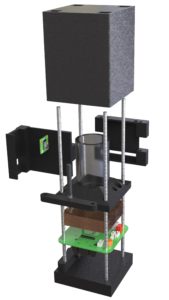
The Nordend payload studies the behavior of plasma-activated water in a microgravity environment. The objective of this experiment is to demonstrate that it is possible to produce disinfectant in space.
Structure
Nordend is built around an internal structural frame, providing high robustness, easy access, and excellent modularity. It uses CFRP rods (carbon-fiber-reinforced polymer) combined with aluminum rings, surrounded by panels adapted to the needs of each subsystem (simple panels, antennas, or fins).
Its unified threaded coupling system ensures a proven, fast, and reliable mechanical connection.
Some couplers also integrate structural sensors, allowing real-time monitoring of the vehicle’s structural integrity.
Its coaxial aluminum tanks are designed to contain the propellants at a pressure of 40 bar. Innovatively, Nordend includes a removable internal fuel tank, which simplifies filling operations.
To attach the vehicle to the launch rail, a retractable attachment system is integrated, reducing aerodynamic drag during flight.
This vehicle is one of the most high-performance designs produced by the Structure subsystem, with a mass limited to 17.8 kg for a length of 3.69 m.

Recovery
To ensure the rocket reaches the ground safely, a new recovery system was developed. Instead of using two parachutes, a single parachute with a regulated canopy is used.
At the bottom of the parachute, a Dyneema cord passes through several rings to prevent full deployment.
The parachute deploys at apogee (~3000 m) and slows the rocket to 27 m/s.
At 400 m altitude, this cord is cut using a nichrome wire system, allowing the parachute to fully deploy and slow the rocket to 6 m/s for landing.
Bi-Liquid
Propulsion
A2, the team’s first flight-ready bi-liquid engine, is designed to propel Nordend to its 3 km apogee. The engine operates using a mixture of nitrous oxide and 90% ethanol, with an additive (TEOS) that helps maintain lower temperatures.
The engine is not actively cooled. Instead, it relies on several mechanisms including ablative cooling, film cooling, the TEOS additive, and a fully graphite nozzle capable of withstanding extremely high temperatures while remaining lightweight.
Propellant injection uses a pintle injector configuration: the fuel enters the combustion chamber axially, while the oxidizer is injected radially from the central pintle feature. This creates a collision between the two fluids, ensuring complete mixing.
Similarly to a COTS solid rocket motor, the injector and the nozzle are screwed into the combustion chamber. Metal seals are used instead of O-rings because they can withstand extremely high temperatures without degrading.